PTZ vs Fixed Camera: What’s the Difference & Which One Should You Choose?
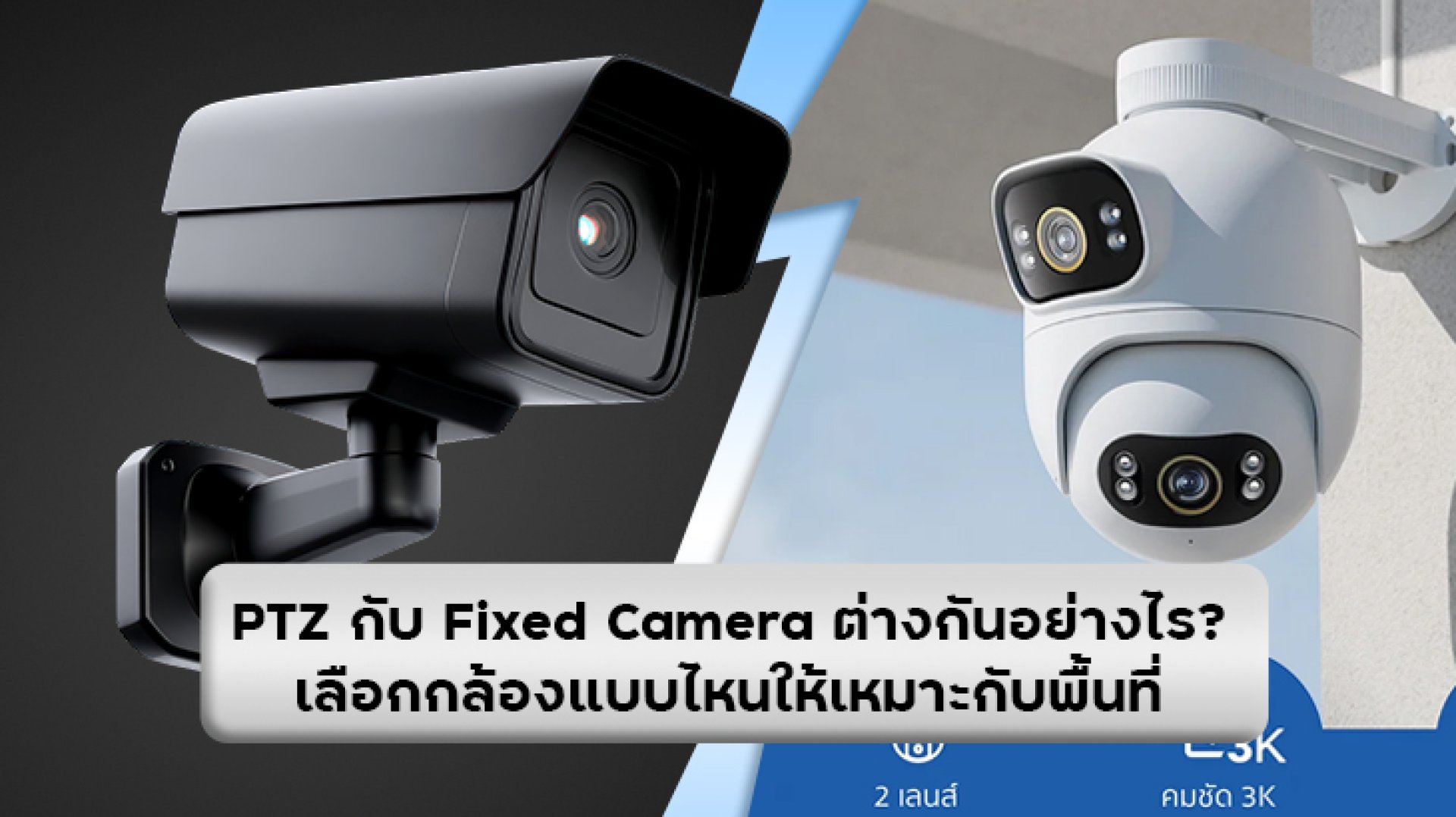
If you are comparing PTZ vs Fixed Camera for a security camera system, you may wonder which type is better and which one is more suitable for your property. Both camera types are designed for surveillance, but they work in very different ways.
A PTZ Camera can pan, tilt, and zoom, allowing you to change the viewing direction and inspect objects at different distances. A Fixed Camera, on the other hand, stays in a fixed position and continuously monitors the area where it is installed.
That means the real question is not simply whether PTZ is better than Fixed Camera. The better choice depends on whether you need flexible viewing or continuous coverage of specific areas.
PTZ vs Fixed Camera: Whats the Difference?
The biggest difference is simple: a PTZ Camera can move and change its viewing direction, while a Fixed Camera remains pointed at a predetermined area.
PTZ stands for Pan-Tilt-Zoom. Pan allows the camera to rotate left and right, Tilt moves the camera up and down, and Zoom allows it to magnify distant objects.
Many PTZ models also support Optical Zoom, which uses the physical lens system to magnify distant subjects rather than simply enlarging the image digitally.
| Feature | PTZ Camera | Fixed Camera |
|---|---|---|
| Camera movement | Pan and Tilt | Fixed viewing angle |
| Zoom | Many models support Optical Zoom | Depends on the lens |
| Coverage | Can change viewing direction | Monitors a specific area |
| Auto Tracking | Available on supported models | Cannot physically follow a target |
| Tracking moving objects | Possible with supported features | Limited to the camera's field of view |
| Typical use | Large or open areas | Specific surveillance points |
What Is a PTZ Camera?
A PTZ Camera is a security camera designed to change its viewing direction and zoom level remotely. The name comes from three main functions: Pan, Tilt, and Zoom.
What Is Pan?
Pan means rotating the camera horizontally from left to right. This allows the camera to monitor different areas without physically moving the camera itself.
What Is Tilt?
Tilt means moving the camera vertically up and down. This is useful when monitoring areas with different elevations or when the camera needs to change its viewing angle.
What Is Zoom?
Zoom allows the camera to enlarge distant subjects. PTZ cameras equipped with Optical Zoom use the lens to magnify the image, which can provide better detail than relying on Digital Zoom alone.
This makes PTZ cameras particularly useful for factories, warehouses, parking lots, construction sites, stadiums, and large outdoor areas.
What Is a Fixed Camera?
A Fixed Camera is a security camera designed to monitor a specific area from a fixed position. Once installed, the camera does not physically rotate or tilt to follow a moving target.
The main advantage is simplicity. Once the camera is correctly positioned, it can continuously monitor the intended area without changing direction.
For example, if you want to monitor an entrance door, a Fixed Camera positioned directly toward the entrance can provide continuous coverage of that specific area.
Fixed Cameras are therefore commonly used for entrances, corridors, walkways, reception areas, loading zones, and building perimeters.
Where Is a PTZ Camera Most Suitable?
PTZ cameras are particularly useful in large areas where the operator needs to change the viewing direction or inspect multiple locations from a single installation point.
Common applications include:
- Factories
- Warehouses
- Parking lots
- Construction sites
- Large outdoor areas
- Industrial facilities
- Large building perimeters
PTZ cameras with Auto Tracking can also use supported detection technologies to follow moving people or vehicles within the camera's operational range.
Where Is a Fixed Camera Most Suitable?
Fixed Cameras are ideal when you need continuous monitoring of specific locations and do not need to change the camera's viewing direction.
Typical applications include:
- Entrance doors
- Back doors
- Walkways
- Stairways
- Loading areas
- Retail counters
- Building entrances and exits
- Residential properties
For these applications, a Fixed Camera can provide consistent coverage without the complexity of motorized movement.
PTZ 1 Camera vs Multiple Fixed Cameras
This is one of the most important considerations when designing a surveillance system. In some situations, you can choose between installing one PTZ Camera or using multiple Fixed Cameras.
A PTZ Camera can rotate between different areas. If you want to inspect the left side, you can move the camera there. If you need to check another area, you can rotate it again.
Multiple Fixed Cameras work differently. Each camera continuously monitors its own area, allowing several locations to be monitored simultaneously.
The key difference can therefore be summarized as:
PTZ = Change the viewing direction to monitor different areas.
Multiple Fixed Cameras = Monitor multiple areas simultaneously.
This is why a PTZ Camera should not automatically be considered a replacement for multiple Fixed Cameras.
Advantages of PTZ Cameras
The biggest advantage of a PTZ Camera is flexibility. A single camera can change its viewing direction and, on supported models, zoom into distant objects.
1. Flexible Viewing Direction
PTZ cameras can pan and tilt, allowing operators to remotely change the area being monitored.
For example, a PTZ installed in a large parking lot can be directed toward different sections without installing another camera for every viewing direction.
2. Suitable for Large Areas
PTZ cameras are well suited to large open areas where the operator needs to inspect different locations from a single position.
Models with higher Optical Zoom capabilities can also help inspect distant objects in greater detail.
3. Optical Zoom
Many PTZ cameras include Optical Zoom such as 10x, 20x, or 30x. Optical Zoom uses the physical lens system to magnify distant subjects.
This differs from Digital Zoom, which enlarges the existing image through software and can reduce visible detail at higher magnification levels.
4. Auto Tracking
Some PTZ cameras support Auto Tracking, allowing the camera to follow detected people or vehicles as they move through the monitored area.
This can be particularly useful in large outdoor spaces where a fixed viewing angle cannot cover the entire area.
Limitations of PTZ Cameras
1. A PTZ Cannot Watch Every Direction at the Same Time
This is one of the most important limitations of PTZ cameras.
Although a PTZ can rotate in different directions, it can only actively view one direction at a time. If the camera is facing one side of a property, an event occurring on the opposite side may not be captured in detail at that exact moment.
Multiple Fixed Cameras have an advantage here because each camera can continuously monitor its own area.
2. More Complex System
PTZ cameras may include motors, moving mechanisms, Optical Zoom, Auto Tracking, and additional control features. This makes the system more complex than a basic Fixed Camera.
3. Higher Cost in Many Cases
PTZ cameras with Optical Zoom and advanced AI features are often more expensive than basic Fixed Cameras.
However, the total system cost should be considered rather than simply comparing the price of one camera against another.
Advantages of Fixed Cameras
1. Continuous Monitoring
Once correctly installed, a Fixed Camera continuously monitors its designated area without changing direction.
This makes it suitable for entrances, loading zones, corridors, and other important surveillance points.
2. Multiple Cameras Can Monitor Multiple Areas
Multiple Fixed Cameras can be installed at different positions, with each camera covering a specific zone.
For example, a factory may use one camera for the entrance, another for the production area, and another for the loading zone.
3. Simpler System
Fixed Cameras do not require Pan and Tilt motors, making their physical design simpler than PTZ systems.
4. Wide Range of Options
Fixed Cameras are available in different designs, including Bullet, Dome, Turret, and indoor models, making them suitable for a wide range of installation environments.
Limitations of Fixed Cameras
1. Fixed Viewing Direction
Once installed, a Fixed Camera cannot remotely rotate toward another area. If you need additional coverage, another camera may be required.
2. Large Areas May Require Multiple Cameras
Large properties may require several Fixed Cameras to achieve adequate coverage. This can increase the number of cameras, network ports, cables, and storage requirements.
3. Cannot Physically Follow a Moving Target
Fixed Cameras can detect people or vehicles within their field of view when supported by AI features, but they cannot physically rotate to follow a target outside the camera's viewing angle.
PTZ vs Fixed Camera: Which Is More Cost-Effective?
The answer depends on the surveillance requirements.
If you need to monitor several directions but do not need to record every area simultaneously, a PTZ Camera may reduce the number of cameras required.
However, if several important locations must be monitored continuously, multiple Fixed Cameras may provide better coverage even if more cameras are required.
When calculating the total cost, consider camera price, number of cameras, NVR capacity, storage, networking, installation, and maintenance.
Can PTZ and Fixed Cameras Be Used Together?
Yes. In fact, combining PTZ and Fixed Cameras can be an effective surveillance strategy.
Fixed Cameras can continuously monitor critical areas while a PTZ Camera handles large open areas, event investigation, and long-distance inspection.
For example, a factory could use:
- Fixed Camera: Main entrance
- Fixed Camera: Loading area
- Fixed Camera: Warehouse entrance
- Fixed Camera: Critical indoor areas
- PTZ Camera: Parking lot and outdoor perimeter
This creates a combination of continuous coverage from Fixed Cameras and flexible surveillance from PTZ.
Should You Choose PTZ or Fixed Camera for Optical Zoom?
If your main requirement is to inspect distant objects, a PTZ Camera with Optical Zoom is often the more flexible choice.
The advantage is not only the ability to zoom. The camera can first move toward the target and then use Optical Zoom to inspect it in greater detail.
Some Fixed Cameras also support motorized varifocal lenses, but their viewing direction remains fixed after installation.
If you want to understand the difference between Optical Zoom and Digital Zoom in more detail, see our related article: What Is Optical Zoom? How Is It Different from Digital Zoom?
How to Choose Between PTZ and Fixed Camera
Before purchasing a security camera, consider the following questions:
- How large is the area you need to monitor?
- Do you need to monitor multiple locations simultaneously?
- Do you need to track moving people or vehicles?
- Do you need Optical Zoom?
- Do you need Auto Tracking?
- Do important areas need continuous recording?
- Can you install cameras at multiple locations?
- How much detail do you need at long distances?
- Will the camera be installed indoors or outdoors?
- What is your total system budget?
If most of your requirements involve changing the viewing direction, tracking moving targets, and inspecting distant objects, a PTZ Camera may be the better choice.
If your priority is continuous coverage of multiple fixed locations, multiple Fixed Cameras may be more suitable.
PTZ vs Fixed Camera: Final Verdict
PTZ and Fixed Cameras are designed for different surveillance requirements.
A PTZ Camera is ideal for large areas where you need flexible viewing, long-distance inspection, Optical Zoom, or Auto Tracking.
A Fixed Camera is ideal for specific locations that require continuous monitoring, such as entrances, corridors, loading zones, and building perimeters.
The easiest way to remember the difference is:
Need to move the camera between different areas? → PTZ.
Need to monitor several areas at the same time? → Multiple Fixed Cameras.
For larger surveillance systems, using PTZ + Fixed Cameras together can often provide the best balance between continuous coverage and flexible monitoring.
Frequently Asked Questions (FAQ)
What is the difference between PTZ and Fixed Camera?
A PTZ Camera can pan, tilt, and zoom, while a Fixed Camera remains pointed at a fixed viewing angle.
Is PTZ better than a Fixed Camera?
Not necessarily. PTZ is better suited to large areas and flexible monitoring, while Fixed Cameras are better for continuously monitoring specific locations.
Can one PTZ replace multiple Fixed Cameras?
In some situations, yes. However, multiple Fixed Cameras are better when several areas need to be recorded simultaneously.
Is PTZ suitable for home security?
Yes, especially for large properties, gardens, parking areas, or outdoor spaces. For specific points such as doors and walkways, Fixed Cameras are often sufficient.
Can Fixed Cameras have Optical Zoom?
Yes. Some Fixed Cameras use motorized varifocal lenses or other zoom-capable lens systems. However, the camera itself still has a fixed viewing direction.
Is PTZ good for parking lots?
Yes. PTZ cameras are well suited to large parking lots because they can change viewing directions and use Optical Zoom to inspect distant objects. Fixed Cameras should still be considered for entrances and other critical areas.
Should I use PTZ or Fixed Cameras in a factory?
For large factories, using both can be effective. Fixed Cameras can monitor critical points continuously, while PTZ cameras can cover large outdoor areas and provide long-distance inspection.
Which camera is better for Auto Tracking?
A PTZ Camera with Auto Tracking is the better choice when you want the camera to physically follow a moving person or vehicle.
Does every PTZ Camera have Optical Zoom?
No. Optical Zoom is model-dependent. If long-distance viewing is important, check the camera specifications and Optical Zoom capability before purchasing.