PTZ or Fixed Camera? How to Choose the Right One for Your Situation
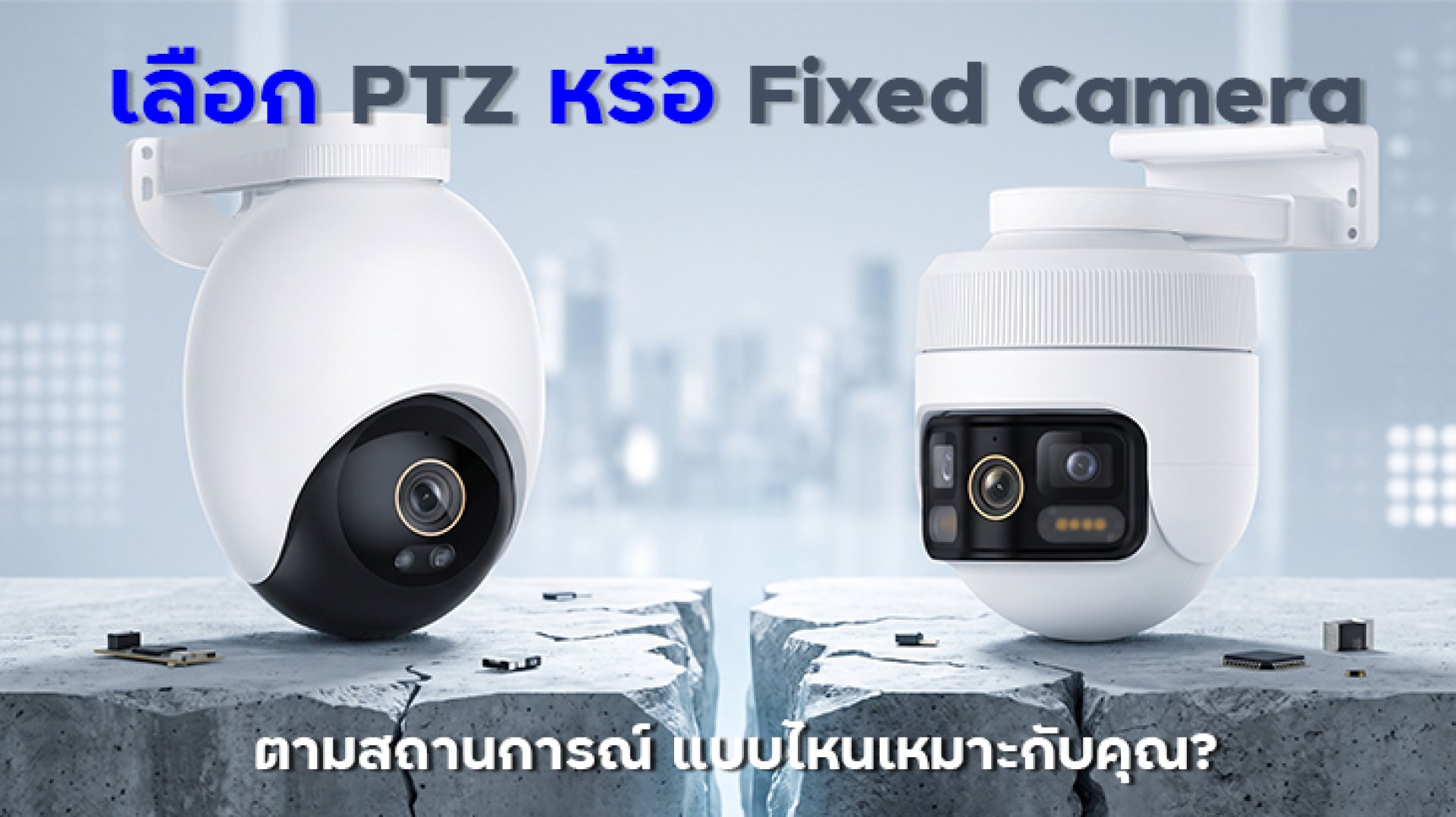
Choosing between a PTZ and Fixed Camera should not be based simply on which camera has more features. These two camera types are designed for different surveillance requirements.
A PTZ Camera can Pan, Tilt, and Zoom, allowing you to change the viewing direction and inspect distant objects. A Fixed Camera, on the other hand, stays pointed at a specific area and is designed for continuous monitoring.
Instead of asking which camera is better, start with a more useful question: What do you need the camera to do?
PTZ or Fixed Camera: A Quick Guide
| Situation | Recommended Option | Main Reason |
|---|---|---|
| Monitoring a front door | Fixed Camera | Continuous coverage of a specific point |
| Monitoring a large garden or property | PTZ | Flexible viewing direction |
| Retail store or counter | Fixed Camera | Clearly defined surveillance areas |
| Parking lot | PTZ + Fixed | Combines wide-area monitoring with fixed coverage |
| Warehouse | Fixed + PTZ | Fixed cameras cover key zones while PTZ covers open areas |
| Large factory | Fixed + PTZ | Provides both continuous coverage and flexible monitoring |
| Long-distance Optical Zoom | PTZ | Suitable for flexible viewing and distant inspection |
| Monitoring multiple points simultaneously | Multiple Fixed Cameras | Each camera continuously monitors its own area |
1. Monitoring a Front Door: PTZ or Fixed Camera?
If your main goal is to monitor a front door, a Fixed Camera is usually a straightforward choice. You can position the camera to cover the entrance, walkway, or area directly in front of the property.
The camera remains pointed at the important area, allowing it to continuously record activity around the entrance.
Using a PTZ Camera for a single fixed point may add functions such as Pan, Tilt, and Zoom that you may not actually need.
Best fit for this situation: Fixed Camera
2. Monitoring a Large Garden or Property
The situation changes when you need to monitor a large garden, parking area, or property with several viewing directions.
In this case, a PTZ Camera can be useful because it can rotate toward different areas and adjust its vertical viewing angle remotely.
If the selected model also has Optical Zoom, it can be used to inspect distant objects in greater detail.
However, if there are critical areas that must always be recorded, such as an entrance or gate, consider adding a Fixed Camera. A PTZ cannot continuously look in every direction at the same time.
Best fit for this situation: PTZ or PTZ + Fixed Camera
3. Retail Store: PTZ or Fixed Camera?
Retail stores usually have clearly defined surveillance points, such as entrances, checkout counters, aisles, displays, and back-office areas.
For these locations, Fixed Cameras are often practical because each camera can be positioned toward a specific area and continuously record it.
If the store is large, such as a showroom or a large retail space, a PTZ Camera can be added to provide flexible monitoring across wider areas.
Best fit for this situation: Fixed Cameras as the main system, with PTZ where needed
4. Office: Which Camera Should You Choose?
Most offices have specific areas that need monitoring, such as entrances, reception desks, corridors, and important internal areas.
For this type of environment, Fixed Cameras are often sufficient because each camera can be positioned to cover a defined area.
For large offices or buildings with extensive open areas, a combination of camera types may be more practical than relying on a single PTZ Camera.
Best fit for this situation: Fixed Camera
5. Warehouse: PTZ or Fixed Camera?
Warehouses typically contain both specific surveillance points and large open areas.
For example, loading doors and warehouse entrances can use Fixed Cameras for continuous monitoring, while outdoor yards or large open spaces can benefit from PTZ Cameras.
- Fixed Camera: Warehouse entrances
- Fixed Camera: Loading and unloading areas
- PTZ: Outdoor yards
- PTZ: Large open areas
This approach gives each camera a specific role instead of expecting one camera type to handle every requirement.
Best fit for this situation: Fixed Camera + PTZ
6. Parking Lot: PTZ or Fixed Camera?
Parking lots are one of the situations where PTZ Cameras can be particularly useful. Parking areas can be large, and vehicles or people may move in different directions.
A PTZ Camera can change its viewing direction and, on supported models, use Optical Zoom to inspect distant subjects.
However, using only one PTZ may not provide continuous coverage of every important area. Entrances, exits, payment areas, or other critical points may still benefit from Fixed Cameras.
A practical approach is to use Fixed Cameras for critical points and PTZ Cameras for wider-area monitoring.
Best fit for this situation: PTZ + Fixed Camera
7. Factory: PTZ or Fixed Camera?
Factories can be much more complex than homes or offices. They may include production lines, warehouses, loading zones, entrances, parking areas, and large outdoor spaces.
Using only Fixed Cameras may require many installation points, while PTZ Cameras can help monitor large open areas from a single location.
However, PTZ Cameras should not necessarily be responsible for every surveillance area. Important locations that require continuous recording should still have dedicated Fixed Cameras.
Best fit for this situation: Fixed Cameras as the foundation + PTZ for large areas
8. Tracking People or Vehicles: Which Camera Should You Choose?
If you want the camera to physically follow a moving person or vehicle, consider a PTZ Camera that supports Auto Tracking.
When supported by the camera's detection system, Auto Tracking allows the PTZ mechanism to move the camera as the target moves through the monitored area.
A Fixed Camera remains in its original position, so its ability to follow a moving target is limited to its existing field of view.
However, Auto Tracking does not mean that every PTZ can follow every target in every situation. Performance can depend on the camera model, detection system, lighting conditions, distance, and environment.
Bosch describes Intelligent Tracking as a feature that can move a PTZ camera to follow a selected object until the object leaves the camera's view or tracking is stopped. Bosch BVMS Operation Manual.
Best fit for this situation: PTZ with Auto Tracking
9. Need Optical Zoom? Choose PTZ or Fixed Camera?
If your main requirement is to change the camera direction and zoom in on distant subjects, a PTZ Camera with Optical Zoom is worth considering.
The camera can first move toward the target and then use Optical Zoom to inspect it in greater detail.
Some Fixed Cameras also support motorized varifocal lenses. However, the camera itself remains fixed in its installed direction.
Optical Zoom should also not be confused with Digital Zoom. Optical Zoom uses the camera's lens system, while Digital Zoom enlarges the image electronically.
For more information, see our related article: What Is Optical Zoom? How Is It Different from Digital Zoom?
Best fit for this situation: PTZ with Optical Zoom
10. Need to Monitor Multiple Areas at the Same Time?
If your priority is to continuously monitor several locations simultaneously, multiple Fixed Cameras have an important advantage.
For example, imagine a factory with three entrances. If all three entrances need to be monitored at the same time, a Fixed Camera can be dedicated to each entrance.
With a single PTZ Camera, the camera has to point in one direction at a time.
The simple rule is:
Need to change the area being monitored? → PTZ.
Need to monitor several areas simultaneously? → Multiple Fixed Cameras.
11. Large Outdoor Areas: Which Camera Should You Choose?
Large outdoor areas such as parking lots, construction sites, sports grounds, and factory perimeters are situations where PTZ Cameras can be particularly useful.
Axis describes PTZ Cameras as suitable for monitoring wide areas and using zoom to investigate detected events. You can learn more from Axis Communications PTZ Cameras.
However, if you need continuous evidence from every part of the property, Fixed Cameras should be considered as well. When a PTZ turns toward another area, the areas outside its current viewing direction are not being actively monitored by that camera.
Best fit for this situation: PTZ + Fixed Camera
12. What If You Have a Limited Budget?
Instead of asking which camera is cheaper, start by asking how many areas need to be monitored and what each area requires.
If you only need to monitor two or three specific points, such as a front door, entrance, and corridor, Fixed Cameras may provide exactly what you need.
If you have a large open area that needs to be inspected from one installation point, a PTZ Camera may reduce the need for additional cameras in some situations.
When calculating the total cost, consider more than the camera price. The system may also require:
- Number of cameras
- NVR capacity
- Storage
- Network equipment
- Power requirements
- Cabling
- Installation
- Maintenance
The right comparison is therefore the total surveillance system cost, not simply the price of one camera.
13. Which Camera Is Easier to Manage?
If you want a straightforward system where every camera has a clearly defined role, Fixed Cameras can be easier to manage because each camera has a fixed viewing direction.
PTZ Cameras can include additional functions such as Pan, Tilt, Zoom, Preset Positions, Patrol, and Auto Tracking, depending on the model.
If you do not actually need these features, a Fixed Camera may be a more straightforward solution.
14. Still Not Sure Whether to Choose PTZ or Fixed Camera?
Try dividing your property into two categories.
Category 1: Areas That Must Always Be Visible
Examples include entrances, doors, counters, loading areas, and other critical locations. These areas should generally be considered for Fixed Cameras.
Category 2: Areas That Need Flexible Monitoring
Examples include parking lots, large yards, construction sites, and factory perimeters. These areas may benefit from PTZ Cameras.
If your property contains both types of areas, a PTZ + Fixed Camera system can divide the responsibilities between the two.
PTZ or Fixed Camera: Scenario-Based Comparison
| Situation | PTZ | Fixed | Recommended Approach |
|---|---|---|---|
| Front door | Usually unnecessary | Suitable | Fixed |
| Large garden | Suitable | Can be used as a supplement | PTZ or PTZ + Fixed |
| Retail store | Useful for larger areas | Suitable | Fixed as the main system |
| Office | Optional | Suitable | Fixed |
| Warehouse | Suitable for open areas | Suitable for critical points | Use both |
| Factory | Suitable for large areas | Suitable for critical points | Use both |
| Parking lot | Highly suitable | Suitable for entrances | Use both |
| Tracking people or vehicles | Suitable with Auto Tracking | Limited to its field of view | PTZ |
| Optical Zoom | Highly suitable | Available on some models | Consider PTZ |
| Monitoring multiple areas simultaneously | Limited | Suitable with multiple cameras | Multiple Fixed Cameras |
Final Thoughts: Choose PTZ or Fixed Camera Based on the Situation
Choosing the right security camera does not mean choosing only one camera type for the entire property. Instead, choose each camera based on the job it needs to perform.
Choose a Fixed Camera when you need continuous monitoring of a specific location, such as a door, entrance, corridor, counter, or loading area.
Choose a PTZ Camera when you need to change the viewing direction, monitor a large area, track a target, or use Optical Zoom to inspect distant objects.
Choose PTZ + Fixed Cameras when your property contains both critical points that require continuous recording and large areas that require flexible monitoring.
The most important principle is simple: do not choose a camera based only on the number of features it has. Choose it based on the layout of the area and the events you need to capture.
References
- Axis Communications PTZ Cameras
- Axis Communications Network Camera Product Types
- Bosch Security Systems BVMS Operation Manual
- Bosch Security Systems Fixed Camera to PTZ Handoff