What Is Optical Zoom? How Is It Different from Digital Zoom?
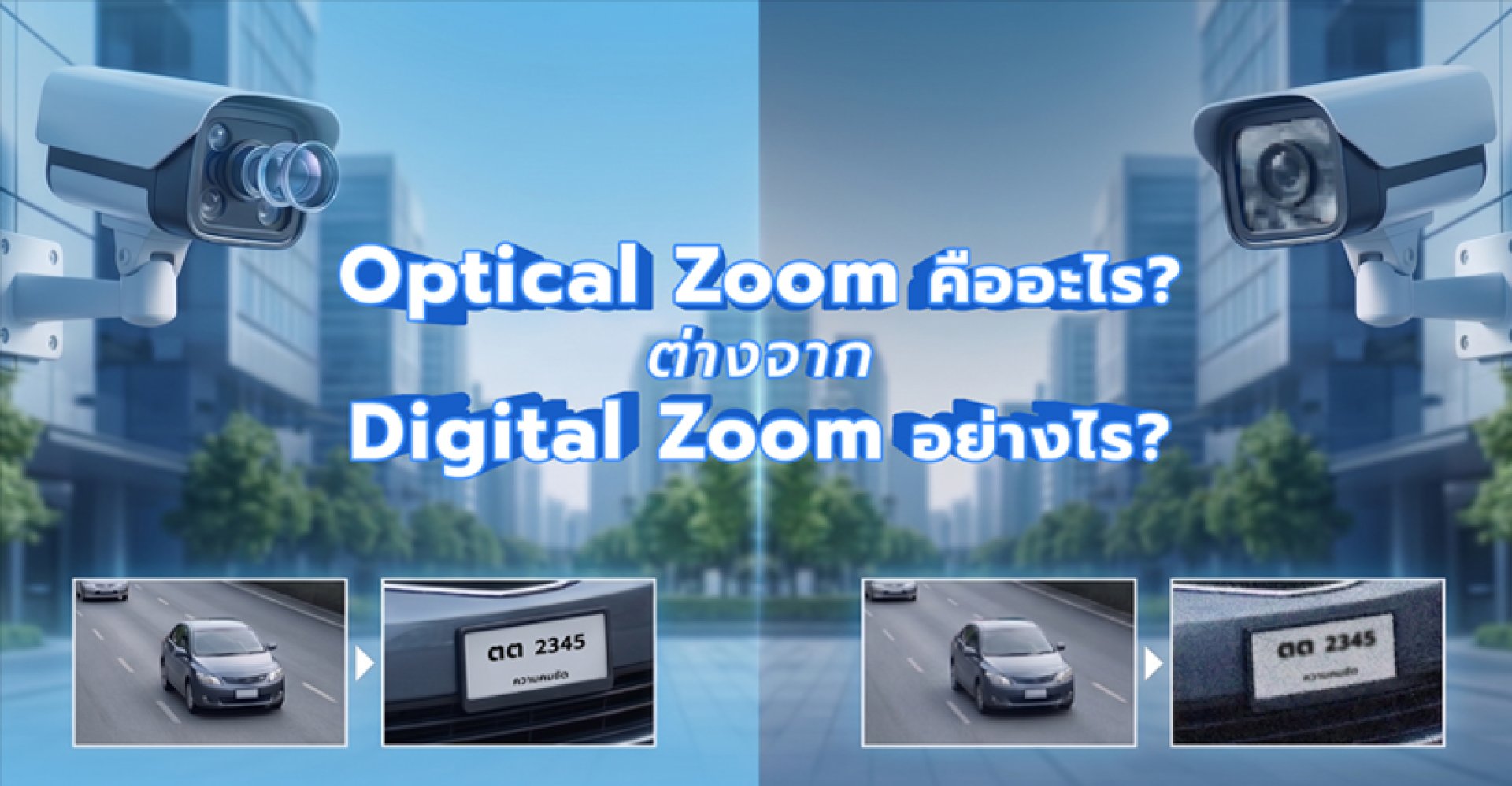
If you're shopping for a security camera and see terms such as Optical Zoom, 5x, 10x, 20x, or 30x, you may wonder what these numbers actually mean and how Optical Zoom differs from Digital Zoom. The key difference is that Optical Zoom uses a physical lens to magnify the subject, while Digital Zoom enlarges the image using software.
This difference directly affects image clarity, detail, and the ability to view distant objects. Optical Zoom is particularly important for PTZ cameras, which are designed to monitor large areas and zoom in on people, vehicles, or other objects from a distance.
What Is Optical Zoom?
Optical Zoom is a camera technology that uses the physical lens system to change the focal length and magnify a subject. Instead of simply enlarging an existing image, the lens adjusts to make the subject appear larger on the camera's image sensor.
The main advantage of Optical Zoom is that it can maintain image detail better than Digital Zoom. This is because the camera uses the optical system to capture the subject rather than simply enlarging pixels after the image has been recorded.
For example, a security camera advertised with 10x Optical Zoom has a lens whose focal length can change across a range with a 10:1 ratio. This allows the camera to switch between a wider field of view and a narrower view for observing distant subjects.
Optical Zoom Does Not Automatically Mean Better Image Quality
Although Optical Zoom has an important advantage over Digital Zoom, a high Optical Zoom rating does not automatically guarantee excellent image quality. The final result also depends on factors such as sensor resolution, lens quality, autofocus performance, lighting conditions, and image processing.
For this reason, you should not choose a camera based only on whether it offers 20x or 30x Optical Zoom. The entire imaging system should be considered.
How Does Optical Zoom Work?
Optical Zoom works by moving elements inside the lens assembly to change the focal length. As the focal length changes, the camera's field of view becomes wider or narrower.
At a wide-angle setting, the camera can capture a larger area, making it useful for monitoring an entire parking lot, storefront, or outdoor space. When the lens moves toward the telephoto range, the field of view becomes narrower and distant objects appear larger.
This is why Optical Zoom is particularly useful in PTZ security cameras. The camera can rotate toward a specific area and then use Optical Zoom to enlarge a distant subject without relying solely on digital image enlargement.
A Simple Example
- Wide-angle view: Useful for monitoring an entire parking lot or building entrance.
- Zoomed view: Useful for viewing a vehicle or person farther away.
- Higher zoom: Useful when you need to inspect a specific distant area.
With Optical Zoom, the camera is not simply enlarging the original image. Instead, the lens changes the optical magnification so the subject occupies more of the sensor during image capture.
What Do 5x, 10x, 20x, and 30x Optical Zoom Mean?
The numbers 5x, 10x, 20x, and 30x describe the ratio between the lens's maximum and minimum focal lengths.
| Optical Zoom | Typical Use |
|---|---|
| 5x | Small to medium areas where both wide and moderately zoomed views are needed |
| 10x | Retail stores, buildings, and medium-range surveillance |
| 20x | Large areas such as warehouses, factories, and parking lots |
| 30x | Long-range surveillance and large outdoor areas |
However, the Zoom number alone cannot tell you exactly how far a camera can see. Actual viewing distance depends on factors such as focal length, sensor size, resolution, lighting conditions, and the size of the object being monitored.
Why Does Optical Zoom Preserve More Image Detail?
The main difference comes down to how the image is captured.
With Optical Zoom, the lens changes its focal length so that the distant subject occupies more of the image sensor during capture. This allows the camera to use the sensor's available image information more effectively.
With Digital Zoom, the camera takes an existing image and enlarges or crops a smaller section of it. Because the original image does not contain additional information, excessive digital enlargement can result in softer or less detailed images.
A simple way to think about it is that cropping a photograph does not create new details. If the original image did not capture enough information about a distant object, enlarging that area cannot truly recover the missing information.
Why Is Optical Zoom Important for Security Cameras?
Optical Zoom is not essential for every security camera installation. However, it becomes extremely useful when you need to inspect distant objects while maintaining as much image detail as possible.
Common applications include:
- Monitoring vehicles in parking lots
- Following people at a distance
- Monitoring building entrances
- Observing large outdoor areas from a single camera position
- Working with Auto Tracking systems
- Using PTZ cameras for large-area surveillance
A PTZ Camera with Optical Zoom can rotate toward a target and then zoom in to inspect it. This makes PTZ systems particularly useful for factories, warehouses, parking lots, and other large properties.
Who Should Use Optical Zoom?
Optical Zoom is most useful for people who need to inspect distant objects rather than simply monitor a wide area.
For example, a camera installed at the entrance of a small home may not need high-powered Optical Zoom if the monitored area is nearby. A large factory, warehouse, or parking lot, however, may benefit significantly from a camera capable of long-range optical magnification.
The appropriate Zoom level should always be selected based on the actual installation distance and the type of detail you need to see, rather than choosing the highest Zoom specification available.
What Is Digital Zoom?
Digital Zoom is a software-based method of enlarging an image. Unlike Optical Zoom, it does not move the physical lens to bring a distant subject closer.
The camera takes a portion of the original image and enlarges it to fill more of the display. The subject therefore appears larger, but the camera has not captured additional optical information about it.
For example, if a security camera records a distant vehicle and Digital Zoom is used to enlarge the vehicle, the vehicle becomes larger on the screen. However, details that were not captured in the original image cannot be recovered simply by increasing the digital magnification.
How Does Digital Zoom Work?
Digital Zoom relies on image processing performed by the camera or viewing software. Depending on the system, the process may involve cropping, resizing, sharpening, or other image enhancement techniques.
As the digital zoom level increases, a smaller portion of the original image is displayed. This can make the image appear softer or less detailed, particularly when the original subject is already small or poorly illuminated.
A Simple Example of Digital Zoom
Imagine a 4K security camera recording a distant vehicle. If you digitally zoom into the vehicle, you are displaying a smaller portion of the original 4K frame at a larger size.
The vehicle may appear larger, but the amount of original visual information has not increased. At higher magnification levels, the image may therefore appear soft or lose fine details.
Why Can Digital Zoom Reduce Image Quality?
The main reason is simple: Digital Zoom does not create additional original image data.
It can enlarge an object on the screen, but it cannot reproduce details that were never captured by the camera's lens and sensor.
Modern cameras may use AI-based image enhancement or computational photography to improve the appearance of digitally enlarged images. These technologies can make an image look better, but they should not be confused with true optical magnification.
Optical Zoom vs Digital Zoom: What's the Difference?
| Feature | Optical Zoom | Digital Zoom |
|---|---|---|
| Zoom Method | Physical lens adjustment | Software-based enlargement |
| Image Detail | Generally preserves more detail | May lose detail at high magnification |
| High Zoom Quality | Generally better | May become soft or pixelated |
| Long-Distance Subjects | Highly suitable | Suitable to a limited extent |
| PTZ Cameras | Commonly used | Can be used as an additional zoom method |
| System Cost | Generally higher | Generally lower |
What If a Camera Has Both Optical and Digital Zoom?
Many security cameras combine Optical Zoom and Digital Zoom rather than relying on only one method.
For example, a PTZ camera may offer 20x Optical Zoom and additional Digital Zoom. The camera uses its optical lens through the 20x optical range. Beyond that range, the system can apply digital magnification to enlarge the image further.
This approach provides greater flexibility, but it is important to understand that image quality generally depends more heavily on the optical system once the camera moves beyond its Optical Zoom range.
Is Optical Zoom More Important Than Digital Zoom?
If your main objective is to view distant objects with greater detail, Optical Zoom is generally more important than Digital Zoom.
This is especially true for security applications such as monitoring vehicles, people, warehouses, factories, and large outdoor areas.
Digital Zoom can still be useful for occasional viewing or when working with high-resolution cameras, but it should not be considered a replacement for a good optical system when long-distance detail is important.
Should You Choose Optical Zoom or Digital Zoom?
The right choice depends on how you plan to use the camera.
- Need to monitor distant objects: Choose Optical Zoom.
- Need to cover a large area: Consider higher Optical Zoom.
- Need to track people or vehicles: Optical Zoom works well with Auto Tracking.
- Monitoring a small indoor area: Digital Zoom may be sufficient.
- Want maximum flexibility: A camera supporting both Optical and Digital Zoom can be useful.
Optical Zoom Is Not the Only Factor That Determines Camera Quality
Even when Optical Zoom is important, it should not be the only specification you consider. A camera with 30x Optical Zoom does not automatically produce better images than every camera with 20x Optical Zoom.
Other important specifications include:
- Camera resolution
- Image sensor quality
- Focal length
- Lens quality
- Autofocus performance
- Low-light performance
- Night vision
- WDR
- Image processing
- AI Detection and Auto Tracking
When choosing a security camera for a large area, consider Optical Zoom + Sensor + Lens + Night Vision + Autofocus as a complete imaging system rather than focusing on the Zoom number alone.
What Is Hybrid Zoom?
Hybrid Zoom, sometimes called Hybrid Optical-Digital Zoom, combines Optical Zoom and Digital Zoom to provide a greater overall magnification range.
The camera first uses Optical Zoom to magnify the subject using its physical lens. Once the optical range is reached, the system can apply Digital Zoom or additional image processing to enlarge the image further.
For example, a camera with 20x Optical Zoom and additional Digital Zoom may advertise a higher total magnification capability. However, this does not mean that the camera has 30x Optical Zoom. The additional magnification is still digital.
Why Use Hybrid Zoom?
Hybrid Zoom gives users more flexibility when monitoring distant subjects. The camera can rely on Optical Zoom for the highest-quality magnification and use Digital Zoom when additional enlargement is required.
For applications where fine detail is critical, however, the actual Optical Zoom specification should receive more attention than the maximum combined Zoom number.
How Is Optical Zoom Related to PTZ Cameras?
PTZ Cameras can Pan, Tilt, and Zoom, making them one of the most common camera types to use Optical Zoom for large-area surveillance.
The process can be summarized in three steps:
- Pan: Rotate the camera toward the target area.
- Tilt: Adjust the camera vertically.
- Optical Zoom: Magnify the target to inspect distant details.
For example, a PTZ camera installed in a parking lot can rotate toward a vehicle, adjust its viewing angle, and use Optical Zoom to inspect the vehicle from a distance.
This combination is particularly useful for factories, warehouses, parking lots, and large outdoor areas.
How Does Optical Zoom Work with Auto Tracking?
Auto Tracking allows compatible security cameras to automatically follow detected people or vehicles. When the system identifies a target, the PTZ mechanism can move the camera to keep the target within the field of view. Depending on the model, the camera may also adjust its zoom level.
When Optical Zoom and Auto Tracking are combined, the system can provide more effective surveillance across large areas.
- AI detects a person or vehicle.
- The PTZ mechanism follows the target.
- Optical Zoom magnifies the target when appropriate.
- Autofocus helps maintain image sharpness.
However, Auto Tracking does not guarantee perfect tracking in every situation. Performance can be affected by lighting, obstacles, target speed, overlapping objects, and the capabilities of the camera's AI system.
Can Optical Zoom Help Capture License Plates?
Optical Zoom can help make a distant license plate appear larger in the image, but Optical Zoom alone does not guarantee successful license plate recognition.
License plate capture depends on factors such as distance, camera angle, image resolution, vehicle speed, lighting, exposure settings, and shutter speed.
If license plate recognition is a primary requirement, a dedicated LPR or ANPR camera designed for that purpose should be considered instead of relying only on a high Optical Zoom rating.
Can Optical Zoom Help Capture Facial Details?
Optical Zoom can make a distant person's face larger within the camera frame, potentially providing more image information for review. However, the ability to identify a person depends on resolution, distance, lighting, camera angle, and overall image quality.
If AI-based facial analysis is required, you should also check the camera and software specifications to ensure that the system supports the required functionality.
How Much Optical Zoom Do You Need?
There is no single Optical Zoom level that is ideal for every installation. The correct choice depends on the distance between the camera and the target, the size of the area, and the amount of detail you need to capture.
5x Optical Zoom
Suitable for small to medium areas where you occasionally need to switch between a wide view and a moderately zoomed view.
10x Optical Zoom
Suitable for retail stores, buildings, and medium-range surveillance applications.
20x Optical Zoom
Suitable for larger areas such as warehouses, factories, and parking lots where distant subjects need to be monitored.
30x Optical Zoom or Higher
Designed for long-range surveillance and large outdoor areas where targets may be located far from the camera.
These are general guidelines only. Actual performance depends on the lens, sensor, resolution, lighting, and installation conditions.
Why Is Focal Length More Important Than the Zoom Number?
Many buyers focus only on numbers such as 20x or 30x. However, the Zoom number is simply the ratio between the maximum and minimum focal lengths of the lens.
For example, one lens might have a focal length range of 550 mm, providing 10x Optical Zoom. Another might use a 10300 mm lens, providing 30x Optical Zoom.
The second camera has a much longer maximum focal length, which can make it more suitable for viewing distant subjects. This illustrates why you should consider Focal Length + Optical Zoom together rather than looking at the x rating alone.
Does Optical Zoom Work at Night?
Yes. However, long-range zoom performance at night can be more challenging because reduced light can affect image detail and autofocus performance.
When selecting a camera for nighttime Optical Zoom applications, consider:
- Infrared (IR) illumination
- Low-light performance
- Wide Dynamic Range (WDR)
- Autofocus
- Image stabilization
- Image processing
Autofocus is particularly important for PTZ cameras because the camera may move between targets and change its zoom level quickly.
What Should You Check Besides Optical Zoom?
If you're choosing a security camera with Optical Zoom, review these specifications together:
- Resolution: Overall image resolution.
- Sensor: Sensor size and image quality.
- Focal Length: The lens's focal length range.
- Optical Zoom: The optical magnification capability.
- Autofocus: How quickly and accurately the camera can focus.
- IR: Nighttime illumination capability.
- WDR: Performance in scenes with strong differences between bright and dark areas.
- AI Detection: Detection of people, vehicles, and other objects.
- Auto Tracking: Automatic tracking of moving targets.
- IP Rating: Protection against water and dust for outdoor installations.
Is Optical Zoom Worth It?
If you only need to monitor a small nearby area, Optical Zoom may not be necessary. A properly selected Fixed Camera may provide better value.
However, if you need to monitor a large area and inspect distant objects, Optical Zoom can provide significant benefits, especially when combined with PTZ and Auto Tracking.
The important question is therefore not whether Optical Zoom is always better, but whether your surveillance environment actually requires optical magnification.
Optical Zoom vs Digital Zoom: Quick Comparison
| Feature | Optical Zoom | Digital Zoom |
|---|---|---|
| Uses a physical lens | Yes | No |
| Software enlargement | Not as the primary method | Yes |
| Maintains detail when zooming | Generally better | Decreases at high magnification |
| Suitable for distant objects | Highly suitable | Suitable to a limited extent |
| Works well with PTZ | Yes | Can be used together |
| System cost | Generally higher | Generally lower |
Conclusion: What Is Optical Zoom?
Optical Zoom is a camera technology that uses a physical lens to change the focal length and magnify distant subjects. Because the magnification occurs through the optical system, it can generally preserve image detail better than Digital Zoom.
Digital Zoom, on the other hand, enlarges or crops an existing image using software. It can make a subject appear larger, but excessive magnification may reduce image detail.
For security cameras used in large areas such as factories, warehouses, parking lots, and outdoor facilities, Optical Zoom can provide significant advantages, especially when combined with PTZ movement and Auto Tracking.
However, don't choose a camera based only on its 5x, 10x, 20x, or 30x Zoom rating. Consider Focal Length, Resolution, Sensor, Autofocus, Night Vision, WDR, and AI Detection together to find the right camera for the actual installation environment.
Frequently Asked Questions (FAQ)
What is Optical Zoom?
Optical Zoom uses a physical lens system to change the focal length and magnify distant subjects. It generally preserves image detail better than Digital Zoom.
What is Digital Zoom?
Digital Zoom enlarges or crops an image using software rather than physically adjusting the lens. Image detail may decrease at higher zoom levels.
Is Optical Zoom better than Digital Zoom?
For viewing distant objects and maintaining image detail, Optical Zoom is generally better than Digital Zoom because it uses the physical lens to magnify the subject.
What does 20x Optical Zoom mean?
20x Optical Zoom means the lens has a maximum-to-minimum focal length ratio of approximately 20:1. It does not mean that the camera can see exactly 20 times farther than another camera.
Is 30x Optical Zoom good?
30x Optical Zoom can be useful for long-distance surveillance, but performance also depends on focal length, sensor quality, resolution, lens quality, lighting, and autofocus.
Do PTZ cameras need Optical Zoom?
Not every PTZ camera requires Optical Zoom, but it is highly useful for PTZ systems monitoring large areas because the camera can rotate toward a target and optically magnify it.
Can Optical Zoom read license plates?
Optical Zoom can help enlarge distant license plates, but it does not guarantee successful recognition. Dedicated LPR or ANPR cameras are recommended for license plate recognition applications.
How much Optical Zoom do I need?
The appropriate Zoom level depends on the distance between the camera and the target, the size of the monitored area, and the amount of detail you need to capture.
Does Optical Zoom work at night?
Yes, but nighttime performance also depends on the sensor, lens, IR illumination, WDR, autofocus, and image processing capabilities of the camera.