What Is Focal Length? How to Choose the Right CCTV Lens for Your Needs
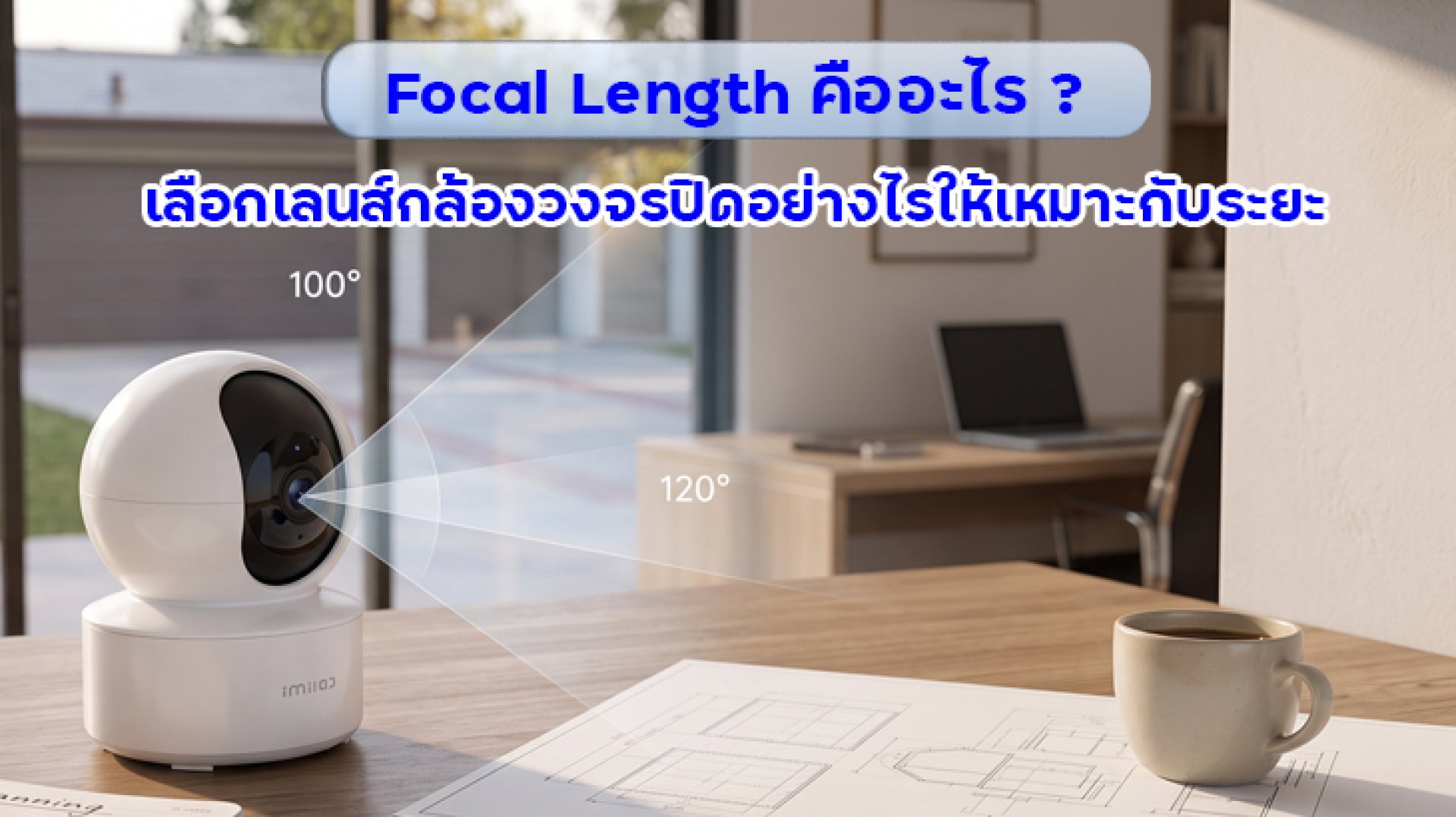
Have you ever installed a high-resolution CCTV camera only to discover that the footage does not show what you expected? Perhaps the camera covers a wide area, but people appear too small to identify clearly. Or maybe the image brings distant objects closer, but too much of the surrounding area is left out. The problem may not be the camera's resolution alone. The lens could also be a factor.
Focal length is an optical measurement that affects a camera's field of view and how large objects appear in an image. For CCTV cameras using the same sensor size, a shorter focal length generally provides a wider view, while a longer focal length provides a narrower view that makes objects appear larger in the frame.
This guide explains what focal length means, compares 2.8mm, 4mm, and 6mm CCTV lenses, and shows how to choose a lens for entrances, driveways, garages, shops, and other areas that require security monitoring.
What Is Focal Length in a CCTV Camera?
Focal length is an optical measurement of a lens, expressed in millimeters (mm). It is closely related to the camera's field of view (FOV) and the size of objects projected onto the image sensor.
When comparing CCTV cameras with the same sensor size, the general rule is:
- Short focal length, such as 2.8mm: Provides a wider field of view, making it suitable for capturing an overview of an area.
- Medium focal length, such as 4mm: Provides a narrower view, offering a balance between overall coverage and subject detail.
- Longer focal length, such as 6mm or more: Provides a narrower field of view, making objects appear larger in the frame at the same distance.
However, focal length is not the only factor that determines how much detail a camera can capture. Sensor size, resolution, installation position, lighting, and image quality also affect the final result.
Comparing 2.8mm, 4mm, and 6mm CCTV Lenses
These focal lengths are common options in security cameras, but each suits different monitoring requirements. There is no single focal length that is best for every installation.
| Focal Length | Field of View | Typical Applications | Key Consideration |
|---|---|---|---|
| 2.8mm | Wide | Living rooms, shops, garages, and front yards where broad coverage is important | Distant objects may appear small in the image. |
| 4mm | Medium | Entrances, corridors, and areas where a balance between coverage and detail is needed | Covers less of the surrounding area than a wider lens. |
| 6mm | Narrower | Specific entry points, long corridors, and areas where a particular subject needs more emphasis | Requires careful positioning because less of the surrounding area is visible. |
Note: The actual field of view depends on the sensor size and lens design. These examples are general guidelines. Check the manufacturer's published FOV specifications for the camera you intend to purchase.
1. When Should You Choose a 2.8mm CCTV Lens?
A 2.8mm lens is useful when you want a camera to cover a relatively wide area in a single frame. Common examples include front yards, living rooms, garages, and shop interiors.
Its main advantage is broad coverage, particularly when the camera is installed relatively close to the area being monitored. However, people or objects farther away may occupy only a small portion of the image, making fine details harder to identify.
A 2.8mm lens is suitable for:
- Monitoring an overall view of a room or shared space
- Covering several areas around a home's entrance
- Observing the general activity inside a retail store
Keep in mind: If you need to read license plates or identify details of people at a distance, evaluate the field of view and the number of pixels available on the target. A wide-angle lens may not provide enough detail for these tasks.
2. When Is a 4mm CCTV Lens a Good Choice?
A 4mm lens is worth considering when you need a narrower view than a 2.8mm lens provides but still want to retain some surrounding context.
For example, a camera positioned near a doorway, corridor, or frequently used entrance may benefit from a more focused field of view. With the same sensor size and installation distance, a 4mm lens generally makes a subject appear larger in the frame than a 2.8mm lens.
A 4mm lens is suitable for:
- Home or building entrances
- Corridors with clearly defined boundaries
- Areas where both the target and some surrounding activity need to remain visible
Before choosing a 4mm lens, check that the camera can still cover all important areas, particularly the sides of a doorway or corridor.
3. Is a 6mm Lens Better for Long-Distance Monitoring?
A 6mm lens, or one with a longer focal length, provides a narrower field of view. This makes it more suitable for focusing on a specific area rather than capturing a broad overview.
Examples include a particular entrance lane, a long corridor, or a location where a person or object needs to appear larger in the image. However, choosing a longer focal length does not automatically guarantee clear details at every distance. Resolution, lighting, camera angle, and subject movement remain important.
A 6mm or longer lens may be suitable for:
- Areas with a single, clearly defined monitoring point
- Entrances where vehicle or pedestrian movement follows a predictable path
- Locations where focusing on a specific subject is more important than broad coverage
Important consideration: A narrow field of view can create blind spots. If you need to monitor a wide area and capture details at a distance, consider using multiple cameras or a model with an adjustable lens.
How Does Focal Length Affect CCTV Installation Distance?
Choosing a suitable focal length starts with two questions: How much of the area do you need to see, and how far away is the subject you want to monitor? You should not select a lens based on its millimeter rating alone.
Use these examples as a starting point:
| Installation Scenario | Lens Selection Guideline |
|---|---|
| Monitoring the overall view of a room | Start by considering a wide-angle lens, such as 2.8mm. |
| Monitoring an entrance or corridor | Compare 2.8mm and 4mm based on the width of the area. |
| Focusing on an entrance farther away | Consider 4mm, 6mm, or a longer focal length based on the required coverage. |
| Adjusting the field of view after installation | Consider a varifocal camera if the model supports lens adjustment. |
These recommendations are starting points, not guarantees of detection distance or identification accuracy. Actual performance depends on the camera specifications and installation conditions.
What Is the Difference Between Focal Length and Optical Zoom?
Focal length and optical zoom are related, but they are not the same thing.
- Focal length: The lens measurement expressed in millimeters, such as 2.8mm, 4mm, or 6mm. It affects the field of view.
- Optical zoom: The ability of an optical system to change its focal length, allowing the view to move between wider and narrower framing.
- Fixed lens: A lens with a fixed focal length that normally cannot change its field of view by adjusting focal length.
- Varifocal lens: A lens that can be adjusted within a specified focal-length range, allowing the installer to select a suitable field of view.
For example, a camera with a fixed 2.8mm lens has a fixed field of view based on its optical design. A camera with a 2.812mm varifocal lens can adjust its field of view within that range, provided the camera supports the adjustment.
For a more detailed explanation, read What Is Optical Zoom? How Is It Different from Digital Zoom?
4 Factors to Check Before Choosing a CCTV Lens
1. Camera Sensor Size
The same focal length can produce different fields of view when used with sensors of different sizes. Check the manufacturer's FOV specifications for each camera model rather than comparing millimeter ratings alone.
2. Camera Resolution
Higher resolution can provide more image detail, but a camera covering a very wide area may still have too few pixels on the target for reliable identification. Match the resolution and lens to the actual monitoring task.
3. Lighting Conditions
Areas with limited lighting may require consideration of lens light transmission, sensor performance, and night-vision capabilities. Focal length alone does not determine how well a camera performs in low light.
4. Your Monitoring Objective
If you need a broad overview, prioritize coverage. If you need to focus on details at a particular point, assess the distance and the size of the subject in the image. For automatic license plate reading, consider an LPR/ANPR solution designed specifically for that purpose.
Conclusion: How Do You Choose the Right CCTV Focal Length?
Choosing the right focal length helps your CCTV camera capture the scene you actually need. In general, a 2.8mm lens is suitable for wide coverage, a 4mm lens can offer a balance between coverage and subject detail, and a 6mm or longer lens is more suitable for focusing on a specific area.
Before buying, consider the installation distance, area width, sensor size, resolution, and the camera's published field of view. If you are unsure about the ideal framing, a varifocal camera may provide greater flexibility when the model supports lens adjustment.
Remember: a wider lens captures more of the surrounding area, while a narrower lens gives greater emphasis to subjects in the frame. Choose the lens according to your monitoring needs, then consider resolution and other camera features.
Frequently Asked Questions (FAQ)
What does focal length mean in a CCTV camera?
Focal length is the optical measurement of a lens, expressed in millimeters (mm). It affects the camera's field of view and the apparent size of objects in the image. Sensor size must also be considered when comparing cameras.
What is the difference between a 2.8mm and a 4mm CCTV lens?
With the same sensor size, a 2.8mm lens generally provides a wider field of view, while a 4mm lens provides a narrower view and makes objects appear larger in the frame at the same distance.
Can a 6mm CCTV lens see farther than a 2.8mm lens?
A 6mm lens provides a narrower field of view and makes subjects appear larger in the frame when used with the same sensor size. However, the distance at which details remain clear depends on resolution, lighting, installation angle, and the subject itself.
Should I choose a fixed or varifocal CCTV lens?
A fixed lens is suitable when the required field of view is already known. A varifocal lens is useful when you need to adjust the framing to match the installation location. Check the supported focal-length range and compatibility of the specific camera model.
Does a longer focal length always produce a sharper image?
No. A longer focal length narrows the field of view and makes objects appear larger in the frame, but sharpness still depends on lens quality, sensor performance, resolution, focus, lighting, and subject movement.